
How Limfa® Therapy Supports the Rebuilding Side of Bone Health
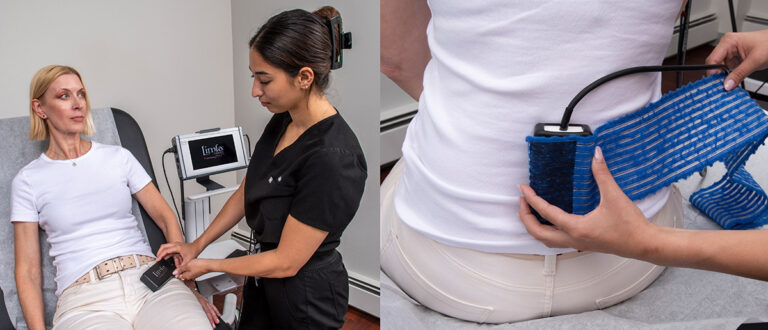
Your bones are constantly listening for signals to rebuild. Every day, old bone is broken down and new bone is laid in its place, and your skeleton stays strong as long as those two processes stay in step with each other. Osteoporosis is what happens when they fall out of step.
That framing matters more than it might seem, because it changes what you’re actually looking for in a treatment. There are two halves to the remodeling cycle, and a given therapy tends to work on one of them. Knowing which half is being addressed — and whether the other half is being addressed at all — is one of the more useful things a patient can understand about their own plan.
At OsteoSmart, we’re the first clinic in the Chicagoland area to offer Limfa® Therapy, a non-invasive, drug-free treatment designed to support bone regeneration at the cellular level. Here’s how it works, and where it fits.
Bone Health Has Two Halves
Bone is living tissue, maintained by two groups of cells working in opposite directions:
Osteoclasts break down old bone. They clear away bone tissue that has aged or become damaged, making room for something better. This is a necessary process, not a malfunction.
Osteoblasts build new bone. They lay down fresh bone matrix to replace what was removed, and they’re the reason a healthy skeleton renews itself continuously throughout life.
In a well-balanced system, these two teams keep pace with one another. With age, and especially after menopause, the balance shifts — more bone comes out than goes back in. Over time, that gap becomes measurable loss in both bone density and bone quality.
So there are two ways to close the gap. You can slow the removal, or you can support the rebuilding. Ideally, you do both.
Where Medication Fits
Most osteoporosis medications belong to a category called antiresorptive drugs, which includes bisphosphonates, denosumab, estrogen therapies, and selective estrogen receptor modulators. According to the Bone Health & Osteoporosis Foundation, these work by slowing the resorption portion of the remodeling cycle.
That’s a meaningful effect, and for many patients it’s the right call. Slowing bone loss stabilizes density and reduces fracture risk, and for someone at high risk of fracture, that protection matters a great deal.
It simply addresses one half of the cycle. A smaller category of medications, called anabolic agents, does stimulate bone formation directly, though these are prescribed less frequently and carry defined treatment windows. For most patients, the first medication offered is one that slows breakdown.
None of this is an argument against medication. It’s an argument for understanding what your plan covers — and asking what’s supporting the rebuilding side.
What Limfa® Therapy Adds
Limfa® Therapy is a pulsed electromagnetic field therapy, or PEMF. It sends ultra-weak electromagnetic signals to the cells that drive your bone-remodeling process.
These low-frequency waves communicate with the cell membrane, helping restore the electrochemical balance and normal function of the cell. When bone cells are working the way they should, the body is better equipped to produce and maintain strong bone. Rather than suppressing turnover, Limfa is designed to strengthen the signal to build.
Research on PEMF technology suggests it may:
- Increase the activity of osteoblasts, the cells that build new bone
- Support the repair and regeneration of bone tissue
- Improve blood flow within bone, which is important for healing
- Activate cellular processes involved in bone formation
A 2023 study published in the Journal of Tissue Engineering and Regenerative Medicine offers a look at the mechanism. Working in an estrogen-deficient laboratory model of postmenopausal osteoporosis, researchers found that PEMF exposure both reduced bone breakdown and increased activity in the body’s bone-building pathways, specifically by engaging BMP/Smad signaling — one of the body’s own natural repair systems. This is preclinical work rather than a human trial, but it helps explain why the clinical results below might look the way they do.
What the Research Shows
The strongest evidence for PEMF in osteoporosis comes from a 2022 systematic review and meta-analysis published in Bioelectromagnetics, which pooled data from 19 separate randomized controlled trials covering a combined 1,303 patients. A review like this carries more weight than any single small study, because it asks whether the same effect keeps appearing across many independent research teams.
Bone density improved. Patients receiving PEMF showed increased bone mineral density at the hip — one of the most important sites for fracture risk, since hip fractures are among the most serious and life-altering.
Pain decreased. Participants reported meaningfully less bone pain than those receiving standard treatment or placebo.
Bone metabolism improved. Blood markers reflecting bone formation and healthy bone metabolism moved in a favorable direction.
The combination performed best. When PEMF was used alongside standard osteoporosis medication, women showed significantly greater improvement in bone mineral density at both the spine and hip than with medication alone.
That last finding is the one we’d point to most often. Limfa isn’t only for patients who want to avoid medication. For someone already on a prescription who wants to do more than hold the line, adding support for the rebuilding side produced better results than the medication by itself.
It’s worth being honest about where the science stands. PEMF is not a replacement for a complete bone health plan, and the research base, while consistent, is still growing. What it does suggest is that the rebuilding half of the cycle responds to being supported — and that’s a real opportunity.
What a Session Is Actually Like
Most patients are surprised by how uneventful it is. You sit comfortably while a pre-programmed protocol delivers the signal. There’s no needle, no radiation, and nothing to take home and remember to swallow.
- No sensation during the session
- No known side effects
- No reported adverse events
The technology is developed and manufactured in Italy and has been used clinically across Europe, supported by more than a decade of clinical research there.
What This Means for You
The way we think about this at OsteoSmart is simple: understand what’s actually happening in your bones first, then build a plan that addresses both halves of the cycle rather than just one.
That starts with knowing where you stand. Our radiation-free REMS bone scan measures not only how dense your bones are but how strong they actually are, so we can see your starting point and track genuine change over time. From there, Limfa® Therapy, nutrition, exercise, and lifestyle support are matched to what your results show.
If you’re exploring osteoporosis care in Chicago or the surrounding suburbs and want to understand every option available to you — with or without medication — we’re here to talk it through. Call (331) 244-1102.
Related Posts
- Limfa® Therapy
- What 19 Clinical Trials Reveal About PEMF Therapy and Bone Density
- How PEMF May Support Your Body’s Natural Bone-Building Process
- Osteoporosis Treatment Without Medication: A Smarter, Non-Drug Approach
References
Lang S, et al. “Pulse Electromagnetic Field for Treating Postmenopausal Osteoporosis: A Systematic Review and Meta-Analysis of Randomized Controlled Trials.” Bioelectromagnetics, 2022;43(6):381–393.
https://pubmed.ncbi.nlm.nih.gov/35864717/
Huang H, et al. “Pulsed Electromagnetic Field Promotes Bone Anabolism in Postmenopausal Osteoporosis through the miR-6976/BMP/Smad4 Axis.” Journal of Tissue Engineering and Regenerative Medicine, 2023.
https://pmc.ncbi.nlm.nih.gov/articles/PMC11919207/
Bone Health & Osteoporosis Foundation. “Medicines for Prevention and Treatment.”
https://www.bonehealthandosteoporosis.org/patients/treatment/medicationadherence/
This article is intended for educational purposes and does not constitute medical advice. Please consult a qualified healthcare provider about your specific bone health needs.