
If Walking Is Your Bone Health Plan, The Data Might Surprise You
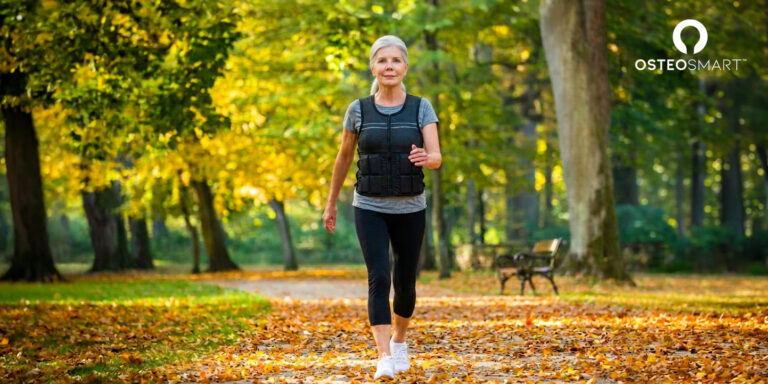
Walking is good for you. Full stop. But if you’re walking to protect your bones — and that’s all you’re doing — the research says it’s not enough.
Here’s why.
Bone is living tissue — and it only builds when it’s pushed.
The more mechanical stress you put on bone, the more your body signals bone cells to build and reinforce. The problem is that walking doesn’t create enough of that stress.
- Walking puts roughly 1–2x your body weight through your bones
- Building bone requires about 3–4x
- That gap is the problem
Swimming and cycling put even less load on your skeleton. Both are excellent for your heart and joints — but because your body is supported by water or a seat, neither does much for your bones.
So what actually works?
The LIFTMOR trial — one of the most cited studies in bone health exercise research — put postmenopausal women on a supervised heavy lifting program. Twice a week for 8 months. Lifting at over 85% of their maximum.
- Spine bone density went up 2.9%
- The light-exercise group? They lost bone.
What does “over 85% of their maximum” mean? In strength training, your one-rep max is the most weight you can lift once with good form. The LIFTMOR participants trained at over 85% of that — in practice, 5 sets of 5 reps at a weight that was genuinely demanding. The last rep should take real focus. Not painful. Just honest strength work. That’s what tells your bones to respond.
In a separate study, six months of strength training twice a week raised spine density by 1.82%. The group that didn’t lift saw no change.
What about walking with a weighted vest?
This is where it gets interesting. A 5-year study of postmenopausal women who wore weighted vests and added jump training three times a week found:
- Femoral-neck (hip) bone density gained 1.54%
- The control group lost 4.43% of their hip bone density
- That’s nearly a 6-point swing
A few things to know before you add a weighted vest to your walks:
- Experts suggest beginning at about 5% of your body weight
- Don’t exceed 10–15%
- If you have existing spinal compression fractures or balance issues, talk to your physician first
Balance is just as important as weight-bearing exercise.
Building bone density and preventing fractures are two different goals — and you need to address both. A strong skeleton doesn’t protect you if your body can’t catch itself in time. That split-second reflexive correction when you stumble quietly diminishes with age, often before people notice it’s gone.
A 2013 BMJ review found that multicomponent exercise programs — combining balance, strength, and gait training — reduced fracture-causing falls by 61%.
At OsteoSmart, we discuss what a personalized weight-bearing exercise program should look like for you — built around your age, strength, and mobility — and pair it with the balance and core stability support that makes it complete.
Our recommendation: Add load progressively. If walking has been your foundation — now it’s time to build on it.
Sources:
LIFTMOR Trial — Watson et al., Journal of Bone and Mineral Research, 2018
Strength training & bone density — Holubiac et al., Sensors, 2022
Weighted vest study — Snow et al. (5-year postmenopausal women study)
Fall prevention — El-Khoury et al., BMJ, 2013
This post is for educational purposes only and does not constitute medical advice. Always consult your physician before making changes to your exercise routine.