
The Pelvic Floor Connection
Why It Matters For Women’s Bones
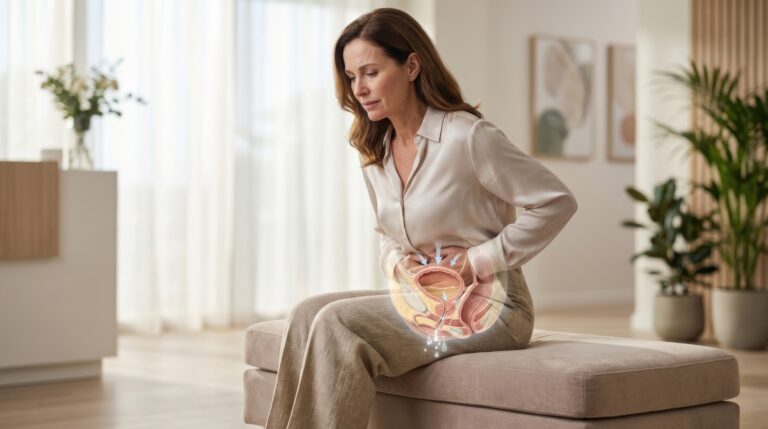
When you think about protecting your bones, the pelvic floor probably isn’t the first thing that comes to mind. But for many women, it’s the missing piece — a muscle group that quietly supports your stability, your posture, and your overall bone health.
That connection was the focus of a recent Happy Bones, Happy Life podcast episode, “Stop Leaking, Lift Stronger,” in which host Margie Bissinger spoke with licensed physical therapist and pelvic floor expert Isa Herrera, MSPT, CSCS. Their message was simple but often overlooked: whether you lift weights, practice balance work, or just want to move through your day with confidence, your pelvic floor plays a key role in stabilization, posture, and strong bones.
Why Your Pelvic Floor Matters for Your Bones
The pelvic floor doesn’t work in isolation. It’s part of a system that includes your core and the connective tissue linking them together — and that system is what gives you stability, good posture, and confident movement. One of the most common mistakes women make is ignoring the connection between the core, the connective tissue, and the pelvic floor.
When you combine proper pelvic floor activation with targeted strength and stabilization work, you support better posture, more reliable balance, and a foundation that helps protect your bones over the long term.
Why the Pelvic Floor Is Essential to Bone Health
Structurally tied to your bones. The pelvic floor is surrounded by the bones of the pelvis and is directly connected to hip function, lower-spine function, and posture — forming the base of your body’s support system.
Essential for skeletal stability. One of the pelvic floor’s primary jobs is stabilization, helping keep your bones aligned and supported. When these muscles weaken, that stability is compromised.
A limiting factor in strength training. Weight-bearing exercise is one of the best ways to load and build bone, but a weak pelvic floor can struggle to support heavier loads. Pelvic floor strength helps determine how safely and effectively you can train.
Integral to core and abdominal function. The pelvic floor works in concert with the abdominal wall. When that connection separates — a condition called diastasis recti — it can destabilize the spine and pelvis and contribute to low back pain, prolapse, and incontinence.
Common, underdiagnosed, and treatable. More than half of older women experience pelvic organ prolapse or incontinence, yet these conditions are often overlooked. Proper evaluation and care support both bone and pelvic health.
How PelviPower® Strengthens the Connection
Knowing the pelvic floor matters is one thing — activating muscles you can’t easily see or feel is another. That’s where OsteoSmart’s PelviPower® therapy comes in.
PelviPower is a noninvasive treatment that uses functional magnetic stimulation to activate and strengthen the deep pelvic floor muscles. Unlike traditional exercises that rely on voluntary muscle engagement — the kind that’s notoriously hard to do correctly — PelviPower delivers thousands of involuntary muscle contractions in a single session, directly reaching the internal stabilizers that are otherwise difficult to activate. You stay comfortably seated while the device does the work, with real-time biofeedback used to customize the intensity.
Here’s why that matters for your bones:
- Improves stability. Strengthening the pelvic and core muscles is designed to support upright posture and steadier balance — key factors in reducing fall risk.
- Supports spinal alignment. A strong pelvic floor reinforces the internal support structures that help protect the spine from postural collapse.
- Non-impact muscle engagement. Because it doesn’t rely on loading or jarring movement, it’s well suited to people with joint pain, bone fragility, or post-fracture limitations.
- Restores function. It helps recondition muscles after periods of immobility, supporting safer, more confident movement.
A strong pelvic floor also supports the core abdominal muscles, contributing to better overall muscle activation, balance, and spinal support — the same foundation Isa Herrera describes as essential for lifting, moving, and building stronger bones.
What This Means for You
At OsteoSmart, supporting the muscles behind balance, posture, and core stability is central to how we help protect bones and reduce fall risk. PelviPower® pairs naturally with the rest of our program — radiation-free REMS bone scanning to measure where you’re starting from, plus personalized nutrition, exercise, and fall-prevention support.
If you’d like help building a safe, effective plan for your own bone health, we’re here to talk it through. Call (331) 244-1102.
References
Bissinger M, Herrera I. “Stop Leaking, Lift Stronger: Pelvic Floor Health for Strong Bones.” Happy Bones, Happy Life Podcast, 2026.
https://youtu.be/g57C1FEpN1g
OsteoSmart. “Fall Prevention — PelviPower® & AccuFit™.”
https://osteosmart.health/our-approach/fall-prevention/
PelviPower® is not suitable for everyone. Contraindications include prior hip replacement surgery, spinal hardware, and a pacemaker or defibrillator. This article is intended for educational purposes and does not constitute medical advice. Please consult a qualified healthcare provider about your specific bone and pelvic health needs.