
The Gut-Bone Connection
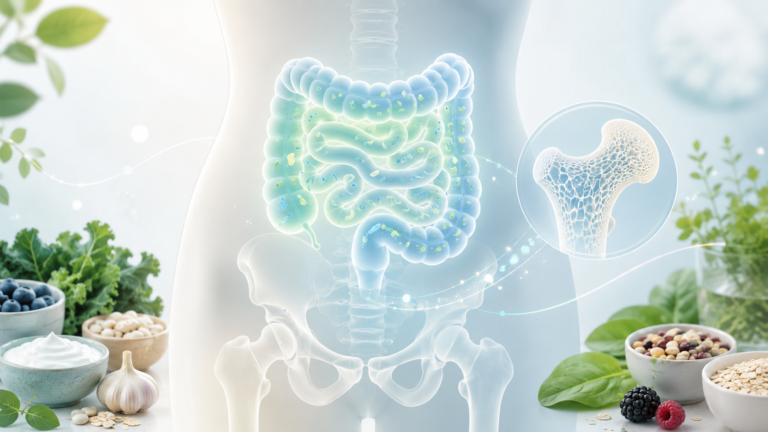
How Your Microbiome Shapes Your Bone Health
When you think about building stronger bones, your digestive system probably isn’t the first place your mind goes. We tend to picture calcium, weight-bearing exercise, maybe a bone scan. But a growing body of research points somewhere less obvious — your gut. The trillions of bacteria living in your digestive tract may have more to say about your bone density than most people realize.
It’s a connection bone health expert Margie Bissinger highlighted on a recent Happy Bones, Happy Life episode, “Osteoporosis Game Changers: Sleep, Strength Training, and Gut Health.” The takeaway was a refreshing one: some of the most powerful levers for your bones aren’t found in a prescription bottle. They’re found in the everyday systems your body already runs — including the one that digests your food.
What Is the Gut-Bone Axis?
Researchers use the term “gut-bone axis” to describe the two-way communication between your gut microbiome — the community of bacteria in your digestive tract — and the cells that build and break down bone. It turns out these two systems are in near-constant conversation. The state of your gut can influence how well you absorb bone-building minerals, how much inflammation circulates through your body, and even the signals that tell your bones to remodel.
In other words, healthy bones may depend on more than what you put in your mouth. They may depend on how well your gut processes it.
How Your Gut Influences Your Bones
The science is still evolving, but several mechanisms help explain the link:
Mineral absorption. You can eat all the calcium, magnesium, and vitamin K you want, but your bones only benefit from what your body actually absorbs. A healthy gut environment supports the absorption of these key bone minerals, while an imbalanced one can leave you absorbing far less than you take in.
Inflammation and immune signaling. Much of your immune system lives in your gut. When the gut lining is compromised or the microbiome falls out of balance, it can drive low-grade, body-wide inflammation — and chronic inflammation is associated with accelerated bone breakdown.
Beneficial metabolites. When gut bacteria ferment fiber, they produce short-chain fatty acids and other compounds that appear to support a healthier balance between the cells that build bone and those that resorb it.
The estrogen link. Certain gut bacteria help regulate circulating estrogen, a hormone closely tied to bone density — one reason gut health may matter even more during and after menopause.
What the Research Shows
A number of studies have begun connecting the dots. Researchers have identified specific gut bacteria associated with bone density in older adults, and early clinical work suggests that supporting the microbiome with probiotics may help slow bone loss in some women with low bone density. Animal studies point to prebiotics — the fibers that feed beneficial bacteria — improving bone mineral content as well.
It’s worth being honest about where the science stands: the effects observed so far are generally modest, and researchers describe gut-focused strategies as a promising complement to — not a replacement for — good nutrition, exercise, and the rest of a well-rounded bone health plan. Still, the direction is encouraging, and it reinforces something we see every day: bone health is whole-body health.
Supporting Your Gut for Stronger Bones
The reassuring part is that the steps that support a healthy gut are the same ones that support your overall well-being — and none of them require a pharmacy. A few worth focusing on:
- Eat a wide range of plants. Diversity on your plate encourages diversity in your microbiome. Aim for a colorful mix of vegetables, fruits, legumes, nuts, and seeds across the week.
- Feed your good bacteria with fiber. Prebiotic-rich foods like onions, garlic, oats, asparagus, and beans provide the fuel beneficial bacteria need to thrive.
- Include fermented foods. Yogurt, kefir, sauerkraut, kimchi, and other fermented foods introduce living, beneficial microbes to your gut.
- Be thoughtful about what disrupts the gut. Unnecessary antibiotics, heavily processed foods, excess alcohol, and ongoing stress can all throw the microbiome off balance.
- Don’t overlook sleep and stress. As Margie’s “Game Changers” conversation underscored, sleep and stress directly affect gut and bone health alike — they’re part of the same picture, not separate from it.
What This Means for You
The gut-bone connection fits the heart of how we think at OsteoSmart: look for the root causes, and address the whole person rather than a single number on a scan. Your bones don’t exist in isolation, and neither does the plan to support them.
That’s why our approach pairs radiation-free REMS bone scanning — so we can see where you’re starting from and track real change over time — with personalized nutrition guidance, exercise, and lifestyle support designed around you. Understanding how systems like your gut feed into your bone health is exactly the kind of bigger-picture thinking that drives better, drug-free results.
If you’d like help building a whole-body plan for your bones, we’re here to talk it through. Call (331) 244-1102.
References
Bissinger M. “Osteoporosis Game Changers: Sleep, Strength Training, and Gut Health.” Happy Bones, Happy Life Podcast, 2024.
https://www.youtube.com/watch?v=sqYW7nzCfq4
Zhang Y-W, et al. “Gut Microbiota Modulation in Osteoporosis: Probiotics, Prebiotics, and Natural Compounds.” Metabolites, 2025.
https://www.ncbi.nlm.nih.gov/pmc/articles/PMC12113025/
Chargo NJ, et al. “Healthy Gut, Healthy Bones: Targeting the Gut Microbiome to Promote Bone Health.” Frontiers in Endocrinology, 2020.
https://www.frontiersin.org/journals/endocrinology/articles/10.3389/fendo.2020.620466/full
This article is intended for educational purposes and does not constitute medical advice. Please consult a qualified healthcare provider about your specific bone health and nutrition needs.